Hi everyone, thanks for checking back on our little trip. We have crossed into Tanzania now, so let's get caught up on how we finished out our wonderful time in Malawi. But first, on my last post I showed photos and talked about the scuba diving in Lake Malawi, but due to a slow internet connection was unable to post the short video I made. I have since updated the previous post with the video, but for anyone who missed it, here is the video again:






As the sun went down on us at Mushroom Farm we spent the evening chatting with each other and the other travelers, and were lucky enough to see some sunset colors, which we were told are rare to see from this area.
Ok, with that out of the way I can get back to my story in chronological order, back where I left off in Monkey Bay.
After our unfortunate departure from Monkey Bay and the argument over money (We later found out this was due to the fact Malawi is having MAJOR political/economic problems which I won't get into here right now. At this point no one trusts the Malawi Kwacha and is thus trying to put their money in US dollars before the value of the Kwacha collapses) we drove a few hours north to another beach spot called Senga Bay. There we stayed at another branch of Mufasas, which was empty besides us, the beach was not nearly as nice as Monkey Bay, and the place was jammed in between other buildings. However, it was just a night and the South African expat who ran the place was very friendly and helpful giving us tips on the rest of our trip. That evening Chris put his can cooking culinary techniques on full display and we ate a strange but tasty meal.
That night was a nearly full moon, and the clouds helped create a very cool looking ring-effect. Chris and I sat out under the stars, the moon and even a clearly visible planet or two while we chatted, listened to the gentle waves of the lake and sipped Carlsburg beers.
In the morning after my typical breakfast of Wheatbix and granola we packed up and headed the roughly 130k to Lilongwe, Malawi's largest city and the head of government and the accompanying NGOs who seem to blanket this country.
Lilongwe is a long way from western standards as far as major cities are concerned, but it had a few shopping malls full of all the South African shops Chris and Weon are familiar with. The city seemed nice enough, distinctly African, but with a few big companies and modern buildings that show westernization and “progress.”
The city also has the third branch of Mufasa's so after driving in circles a few times trying to find it, we were able to set up our tents and settle in for a few days. We were warned that the city had been receiving much higher than average rainfall recently and that if we wanted to could stay in the dorms for the price of camping but we stayed in our tents. I was outside doing a workout and suddenly it started to pour rain. Since I was headed to the shower anyways I stayed out and got wet, when I heard branches breaking and saw a few fall to the ground. A few seconds later a huge section of tree fell just 15 feet from me and on to Weon's tent. From the way it looked I was sure the tent was ruined but it turned out to not have a single scratch! (Later in a bit of a wind storm one of his tent poles broke, likely it was bent or weakened by this incident) Within a block of the lodge, two large trees (and maybe more I didn't see) had been blown over, knocking out power to the whole neighborhood. As I mentioned earlier Lilongwe is a hub of NGOs in Malawi and Mufasa's is a popular place for volunteers to stay while in town. As a result, we spent the evening drinking and chatting with a number of American Peace Corps members as well as a few other assorted volunteers and travelers and had a great time.
Just out exploring the city and the local markets. After watching the local tree/electrical crews cleaning up the downed trees (and them asking for money when I took a photo of it) Chris and I came into this local market, and when you go up a few wooden stairs, you enter what would clearly be described as “the shoe department.” Here you can find all types of used shoes, from dozens and dozens of stands. As you walk through, you see everyone replacing laces, polishing and repairing beat up old shoes to good condition before selling them, recycling in action.
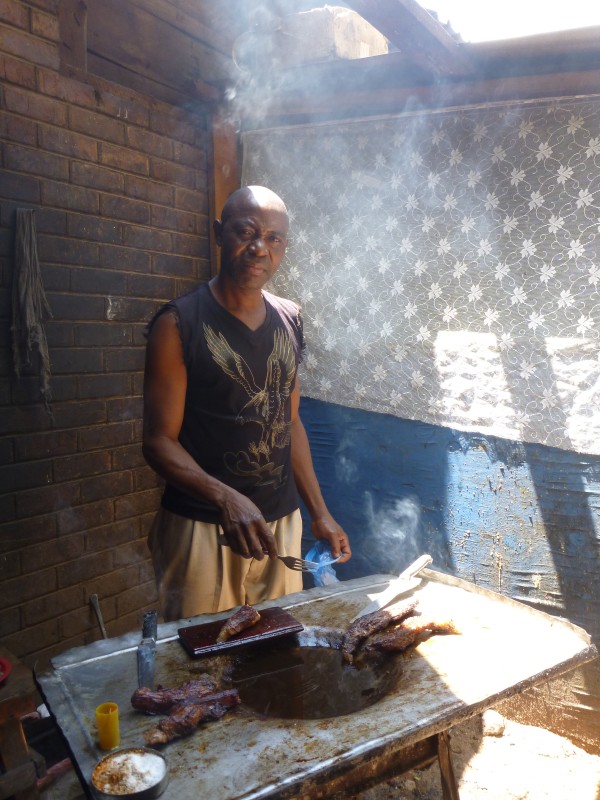
Breakfast consisted of bananas and rolls bought on the street, lunch was made up of some spicy beef I bought from this guy as well as some deep fried potato wedges from the stand opposite. Delicious.
At this point we needed fuel for out truck and were beginning to be clued into the current problems Malawi and it's people are facing. As I think I said in the last post we happened to fuel up on the first day in three weeks Monkey Bay had received any fuel, getting lucky there and now it was time to hunt again. I think we visited four different stations before finding one that actually had gas and this is in the biggest city in the country. After waiting in a chaotic 'line' of honking cars, trucks and mini buses, we managed to fill up our tank. Due to the fuel shortage, it is currently illegal to fill jerry cans, but this little problem was solved by filling them inside of the cab, where clearly it would be impossible to see and figure out what was going on, haha. 46,000 kwacha later we were on our way.
Our destination was an unlikely place called The Shack, and tonight being Wednesday, was the night for western workers and volunteers in the city to gather for what I can only describe as the “I can't believe this is Malawi” beach volleyball tournament. By 8pm the place was going full swing and the fun went late into the night.
While I'm sure there were a few other things to do in Lilongwe, we mostly went for a quick look and to meet a few other people so with that accomplished we set out on the road again, this time for Nkhata Bay.
It was on this stretch that we had out first (minor) problem at a roadblock. We have an early alert system to which guard/police will give us a problem: if they look at the hood of the truck with the picture of us and Mandela and don't smile, then we know they will hassle us. This particular police woman was all frowns and cold questions. Supposedly we are supposed to have a yellow or orange (I forget) reflective strip on the back of our truck, despite the fact many of our stickers are reflective stickers already. We were told this was an automatic fine of 2,000 kwacha (about $12) but somehow Weon talked her out of it and we were on our way. I was shocked we got away without paying, because we have been told the only way police in Malawi get paid anymore is by bringing in enough fines. Anyways, that's our worst experience so far, not too bad.
As we neared out destination, we entered both a rain storm and a very scenic section of rounded stone hills and forests. These forests also happened to be centers for illegal logging done by crews in improvised wood and tarp shelters and portable mills, but they must be paying off the right people because it is out in the open with no attempts to stop it.
Upon our arrival in Nkhata Bay we checked out Big Blue Star, which was shut down for some reason, and another place I forget the name of, but as soon as we saw Mayoka Village it was obvious where to spend out time here. The whole place is a fantastic maze of steep and irregular stairs, bungalows, camping platforms, gardens, a composting toilet, two very cool stone showers and the all important lounge/restaurant/bar area. Once again I was pinching myself and thinking “Am I really in Africa?” At about $4.50 to camp (750 kwacha), it was also a fantastic bargain.
Arriving Friday night was perfect, because that is when they have the big BBQ dinner special. I piled my plate high with chicken, pork, potatoes, salad, eggplant, avocado, carrot and anything else that fit and dug in. Mayoka is without a doubt the happening spot in Nkhata Bay, and travelers, volunteers and locals alike congregate here on the weekends.
The next day Chris and I joined their boat trip, which for 2,000 kwacha I thought was rather overpriced, and even more so when we found they do the boat trip FREE on Tuesdays... Anyways, we loaded up with a few locals, British doctor volunteers, another traveler and set off a few km down the lake.
After stopping at some 5-6m high rocks to jump, dive and flip off which was great fun, and a bit of generally dull snorkeling, we played what they call 'Champion.' What you do is have three sticks, and everyone takes turns jumping over them. Every time they get progressively farther apart and people are weeded out until only one person remains. I can't remember this Swiss guys name (nice guy though), but in the end it was a tie between him and Chris, jumping distances I couldn't even pretend to clear.
On the way back to the lodge, it was time to feed the African fish eagle. The way this was done was by whistling to call its attention, then throwing a fish in the water that had a bit of reed stuck through it so the dead fish would float. The birds put on a good show with their speed and accuracy, then we stopped to watch it eat it's treat while perched in a dead tree.
Bored but still a bit curious about the scuba possibilities Chris and I went to Aqua Africa to inquire about costs, in particular for their night dive where you attract dolphin fish using a light, but at $40 we decided to pass and went off to a local restaurant for a lunch of nsima and chicken, due to the fact they had no fish for some reason. On the way we passed one of the small market areas, and saw this vender selling traditional 'witch doctor' medicine of roots, tree bark and seeds. I wonder which one cures cancer?
The lodge has two dugout canoes that are free to use (as well as a row boat, snorkeling gear, binoculars, bird books and more, I told you this place was cool) and that afternoon I got my chance to try one. Being simply cut out of a single log, it doesn't seem there is a lot of design that goes into these, and every log creates a different boat with different handling characteristics. Due to the shape and the small opening inside, you have to sit on top and quite high, which makes for a tipsy boat. This particular one was the harder of their two (the other had a large bulbous end from the original raw log, that obviously added a lot of stability) to paddle, but I was impressed with the amount of secondary stability it had. However not wanting to swamp the tremendously heavy boat, I was not about to test its limits! At the lodge, they have what they call “The Mayoka Challenge” which is two people have to paddle the tippy boat around the float in the lake and back. Chris and I made it less than one meter. I also found out you can buy one of these for 10,000-15,000 kwacha, but good luck shipping it home!
I used our time here to relax and do a lot of reading, something I haven't managed to do much of up to this point. Making up for lost time, I finished one book, read three more and started a fourth. Book exchanges at lodges often give you strange options to choose from, but I found some fantastic books in Asia that way and the same seems true out here in Africa.
That night happened to be the Africa Cup Final soccer final between Ivory Coast and Zambia, and it was supposed to be a very interesting game. Ivory Coast had all the super stars who play in the European soccer league and was ranked #1 in Africa, while Zambia lacked the star power and somehow reached the finals with a #16 ranking. Not knowing anything about African soccer, I decided to simply root for the underdog, Zambia. A few of us headed off to the local sports bar, which had a huge back room with a projector and sat maybe 100-150 people, probably 95% locals.
All the commentators were predicting an easy win for Ivory Coast, but Zambia held them off the whole game nil-nil and brought it to 30 minutes of overtime, also ending nil-nil. It was shoot-out time. After round one both teams had gone five for five, so it was time for a second round shootout, talk about a nail biter! Finally, Ivory Coast had a shot blocked by Zambia in the second round and the crowd, almost entirely behind Zambia, simply exploded. As Zambia took and made its fifth and final shot on goal to win the game, the hushed crowd again bust into celebration; shouting, screaming, chanting, jumping up and down, and hugging each other. I'd have to say this so far as been one of the highlights of the trip so far, with the same kind of positive energy and excitement as the underground heavy metal show I stumbled upon in India on my Asia trip . Fantastic stuff.
The next day was entirely uneventful, other than walking into town to get some pills for bilharzia, a nasty water borne illness that simply doesn't exist back home. I have no idea if I have come into contact with this while in the lake, but for a 5 minute visit to the clinic and less than $2 of meds, I consider it cheap insurance and it seems stupid not to take the pills, which are taken 6 weeks after the last swim in the lake.
Other than that, I went snorkeling, testing my point-and-shoot camera underwater, a Panasonic DCM-TS3. I have to say I'm impressed with this little camera. It was a hard decision after my little Canon Powershots rough but long life, and I think I made the right one. It's waterproof to 12m, shockproof to 2m, can do pretty good long exposures and has a pretty good rapid-fire mode. Given the limited selection of waterproof cameras, I think this is the top of the bunch and I'm very happy with it.
One of the bungalows with the town of Nkhata Bay in the background.
Our second time on the boat trip, this time free as it was Tuesday.
Me doing some cliff jumping and diving. The classic spot at the 520 bridge in Seattle is a fair bit higher, but this rock was still pretty fun to jump from, and it was because the highest spot I've dove from as well. I took video jumping off with my GoPro, and of everyone else jumping and diving, but it doesn't look all that impressive on film so it might not see the light of day, haha.
This time we played beach soccer with the locals and while I know they were not giving it their full efforts, I somehow managed to score a goal, something I haven't managed to do in a soccer game in a long time! Playing in soft, burning hot sand with a powerful sun overhead was a challenge for sure, and I don't think the game lasted more than 25 minutes if that, but it was great fun.
Being the rainy season, nearly every night since arriving in Nkhata Bay has been filled with lightening and rain storms. Out here when it rains, it pours. At times the thunder is literally ground-snaking, waking many of us from our sleeps at 2 and 3am to watch the sky flash like an irregular strobe light, listen to the machine-gun like rain, and feel thunderclap after thunderclap. Luckily by the time we get out of bed it is long over and even dry by 8 or 9am. I can only imagine what it's like out on those little dugouts fishing on the lake, those lights at the bottom of the photo.
These little lizards are everywhere, and I love them. It seems no matter where you are, these dudes are around to keep you company, moving in their strange jerky fashion, like a skipping CD.
This is Dave. Dave is from Canada. So is his girlfriend Karen. We had a good time chatting on their deck.
So for two days now both my ears had been hurting. At first I thought it was damage from freediving and not equalizing properly, or from the cliff jumping since I'd had that happen before, but once puss started coming out of my ears it was clear I had an infection. I returned to the clinic, got a quick visual inspection and again about 5 minutes and $3 later walked out the door with a bag of antibiotics. For all the problems with health care in Africa, this part of it is sure a hell of a lot better than America.
Local wildlife enjoying some fresh fruit from the tree.
This is about what most nights look like, hanging around with a rotating cast of travelers, locals and drinks. This night Gary, the owner was here to party, and he is nuts. At this point I've met a lot of expat lodge owners on my various travels, many of whom are drunks and stoners, but this guy takes the cake. Although generally a nice guy, he gets rowdy when he drinks and seems to cause a scene every time.
At that point, we had spent a full week at Mayoka Village and it was time to move on. As it turned out, Chris knew someone who was working just 10 or 15km outside of Nkhata Bay as a manager of the saw mill at Vizara Eco Timbers Limited, a rubber tree plantation, so we headed out for a visit.
Johan Gave us a tour of the small saw mill, which recovers timber from the old rubber trees on the plantation. Nearly all the wood cut here is shipped off to South Africa, where it is turned into things such as $1,000 dinner tables.
He walked us through the whole process; cutting the raw timbers into boards, treating them, drying them, bundling and shipping. It's a small mill but they are building a second mill that will increase production. The one number that stood out to me the most was that due to the nature of the rubber trees (size and shape) only 20% of the actual tree becomes finished lumber.
The heart of the operation and the real money maker is the rubber. Again, Johan walked us through the whole process from the nursery where the trees are grafted and grown to the processed rubber which is sold.
Here is a mature section of rubber trees. The tapped rubber is supposed to be collected every day, with each employee responsible for 500 trees.
Here you can see the raw rubber, exactly as it comes out of the tree and into the collection bowl attached to the tree.
After a few simple non-chemical processing steps, the rubber is put into sheets, dried on racks in a smoke room (hence the color) and pressed into 30kg bales to be shipped off and turned into car tires, rubber gloves and even condoms. In the back of this room, you can see the carts where the sheets are dried and moved around, on the right is the press where it is bundled together and farther in the scale to ensure bundles are the correct weight. It was really interesting to see how this is all done, and how amazingly low tech the whole process is. No doubt to turn this material into a condom or something nasty chemicals and high tech processing is required but to this point was about as simple as it gets.
After the tours, we sat around the BBQ and had a delicious dinner of chicken, sweet potatoes and corn, then enjoyed the fire under the stars.
We said our goodbyes (Thanks Johan , it was great!), forgot our kitchen knife, and headed north again towards Livingstonia, a mission town built over 100 years ago in the mountains above Lake Malawi. On the way, we picked up Jannes, another South African who we met at Mayorka. He is hitchhiking and busing through Africa and we were able to help him along on his journey The road off the main highway and the lakeside was 'only 15km' but it is a steep, nasty, rocky, hairpin dirt road that requires a sturdy vehicle. You can walk up for a few hours, drive yourself like we did, or hire a taxi for a whopping $50!
Before finding a campsite, we went to the end of the road to the church built in the 1890s in the town of Livingstonia, and was rewarded with getting to hear a few minutes of their excellent choir. They also have a small university in the town, but we wanted to get camp set up so we didn't have time to look around much.
We ended up at The Mushroom Farm campsite, a nice place currently run by a young traveler couple from America and Sweden, and a place with one of the best views I've seen in Africa so far.
The next morning we set off for the Manchewe waterfall, passing through a few houses, shops and the primary school.
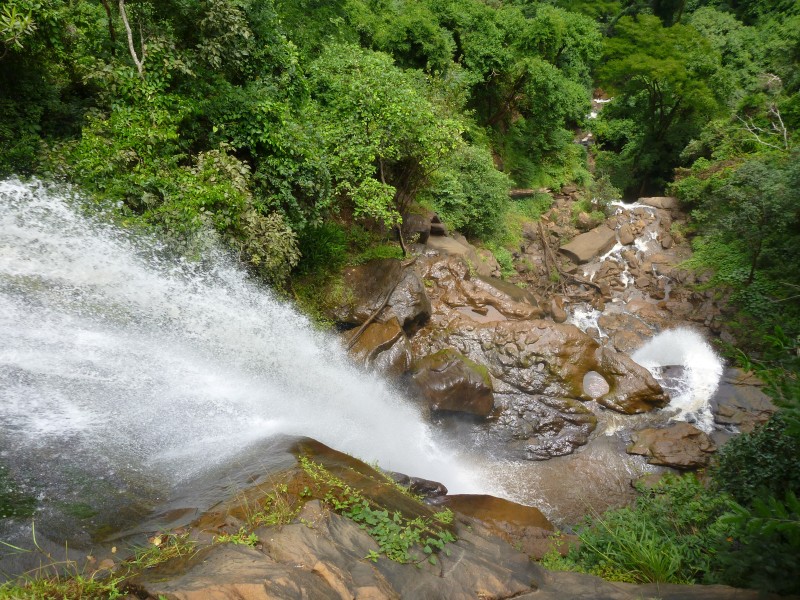
The falls (well, there are actually two) are said to be the highest in Malawi, and they were mighty impressive. This is what it looks like to lean over the edge and look down from the closer of the two falls to the trail.
And here is the second falls, with some imported wildlife ;)
This one I just had to post because the girl is wearing a Pike Place Market t-shirt from my home town of Seattle. I'm always looking and laughing at the cloths that end up out here, I'm waiting for the day I find something of mine!
As the sun went down on us at Mushroom Farm we spent the evening chatting with each other and the other travelers, and were lucky enough to see some sunset colors, which we were told are rare to see from this area.
Up next we will be crossing into Tanzania, where we expect to spent a sizable amount of time on the islands of Zanzibar and Pemba, as well as enjoying some of the worlds best game parks such as the Serengeti. Stick around!


